
Skip to main content Scroll Top

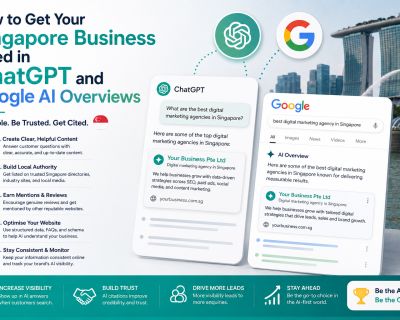
How to Get Your Singapore Business Cited in ChatGPT and Google AI Overviews

Quick Answer
How do you get your Singapore business cited in ChatGPT and Google AI Overviews?
To get cited in ChatGPT and Google AI Overviews, Singapore businesses need to: (1) ensure AI crawlers can access their website, (2) structure content with direct answers and FAQ schema, (3) publish comprehensive question-based content in their area of expertise, (4) build entity authority through third-party citations, reviews and press mentions, and (5) monitor citation performance across AI platforms and adjust accordingly.
Getting cited in ChatGPT, Perplexity and Google AI Overviews is not a matter of luck or mystery. It is a structured, repeatable process — and most of the foundational steps are things any Singapore business can start on today, without a large budget or a technical team.
This guide walks you through the exact steps, in priority order, with specific actions for each. We have applied this process to help Singapore clients across healthcare, insurance, education and B2B services build citation authority across AI platforms. The approach works.
We will cover the technical foundation, content strategy, entity authority building, and how to track your progress. By the end, you will have a clear action plan — not a list of vague recommendations.
Step 1 Fix Your Technical Foundation First

Before any content or authority work can have impact, AI platforms need to be able to read your website. Many Singapore business websites inadvertently block AI crawlers — meaning all the content you publish is invisible to ChatGPT and Perplexity regardless of how well it is written.

Check and fix your robots.txt file
Your robots.txt file tells search engines and AI crawlers which parts of your site they can and cannot access. Check your robots.txt file (find it at yourdomain.com/robots.txt) and ensure it does not block the following AI crawlers:
If any of these are blocked with a Disallow rule, remove the restriction. This is the single highest-priority technical fix for AI visibility.
Implement the right schema markup
Schema markup is structured data that tells AI systems exactly what type of content a page contains and how to interpret it. For AI citation purposes, the most important schema types are:
Ensure fast load times and mobile optimisation
AI crawlers assess page quality signals before deciding whether to include content in their responses. Slow pages and poor mobile experiences are negative signals. Ensure your website loads in under three seconds and passes Google’s Core Web Vitals assessment.
Step 2 Restructure Your Content for AI Extraction
The way most Singapore businesses write website content is not optimised for AI extraction. Long, flowing paragraphs of marketing copy are rarely cited. AI systems extract information from content that is structured, specific and directly answers questions.
Add a Direct Answer section to every key page
At or near the top of every important page — homepage, service pages, blog posts — add a short, clearly labelled section that directly answers the primary question that page addresses. Label it ‘Quick Answer’ or ‘In Brief’. Write it as a clean, standalone paragraph that could be read out of context and still make complete sense.

This is the single most impactful content change you can make. AI engines scan for direct, quotable answers. When they find one at the top of a page, it significantly increases the likelihood of citation.

Use question-based H2 and H3 headings
Structure your blog posts and service pages around the actual questions your customers ask. Instead of a heading like ‘Our SEO Approach’, write ‘How Does SEO Work for Singapore Businesses?’ Instead of ‘Social Media Services’, write ‘What Social Media Platforms Should My Singapore Business Focus On?’
AI platforms match user queries to content headings. Question-based headings create direct, extractable matches.
Add FAQ sections to every blog post and service page
Every blog post and service page should end with a FAQ section containing a minimum of four questions and comprehensive answers. Each answer should be at least 60 to 80 words — long enough to be genuinely useful as a standalone response.

Pair every FAQ section with FAQPage JSON-LD schema (the code version of your FAQ that AI systems can read programmatically). This combination — human-readable FAQ plus machine-readable schema — is one of the strongest citation signals available.

Write with specificity and cite credible sources
Generic content is rarely cited. Content that includes specific statistics, named studies, real examples and credible external references is cited far more frequently. For Singapore businesses, this means:
Step 3 Build Entity Authority Beyond Your Website
Entity authority is how AI systems understand who your brand is and whether it is credible. It is built from signals across the entire web — not just your own website. This is the longest-term element of AI citation building, but it is also the most durable.
Claim and complete every relevant business listing
Ensure your business has a complete, consistent profile on:
Consistency matters: your business name, address and phone number should be identical across every listing. Inconsistency weakens entity signals.
Earn third-party press and editorial mentions
Third-party editorial mentions — in Singapore media outlets, industry publications or credible blogs — are among the strongest entity authority signals available. AI systems place significant weight on brands that are mentioned independently by credible sources.
Practically for Singapore businesses, this means:
Accumulate reviews systematically
Reviews are a public, third-party signal of your business’s credibility and quality. AI systems read and evaluate review sentiment as part of entity authority assessment. For Singapore businesses, Google Reviews are the most important. Aim for:
Step 4 Publish Consistently in Your Area of Expertise
AI systems learn to associate brands with categories through consistent, topically deep content over time. A single well-optimised blog post is useful. A library of thirty well-optimised, interlinked posts on related topics in your category is transformative.
For Singapore businesses starting their AI citation journey, the priority content types are:
Publish a minimum of two to four blog posts per month consistently. Quality over quantity — a single comprehensive, GEO-optimised post will generate more citation authority than four thin, generic posts.
Earn third-party press and editorial mentions
Third-party editorial mentions — in Singapore media outlets, industry publications or credible blogs — are among the strongest entity authority signals available. AI systems place significant weight on brands that are mentioned independently by credible sources.
Practically for Singapore businesses, this means:
Accumulate reviews systematically
Reviews are a public, third-party signal of your business’s credibility and quality. AI systems read and evaluate review sentiment as part of entity authority assessment. For Singapore businesses, Google Reviews are the most important. Aim for:
Step 5 Track Your Citation Performance and Iterate
What gets measured gets managed. Without tracking your AI citation performance, you cannot know whether your efforts are working or where to focus next.
Manual citation testing

The simplest starting point: test your brand manually across AI platforms every month. Ask ChatGPT, Perplexity and Google AI Overviews the questions your target customers would ask, and note whether your brand appears in the responses. Record which platforms cite you, for which queries, and what context your brand is mentioned in.

Track AI referral traffic in GA4
AI platforms that do send traffic to your website will appear in your Google Analytics 4 data. Create a custom channel group for AI referral traffic — include chatgpt.com, perplexity.ai, and other AI platform domains. Monitor this channel monthly to track growth in AI-referred visitors and their conversion behaviour.
Monitor and adjust quarterly
AI citation authority builds over three to six months of consistent effort. Review your citation performance quarterly — what queries are you appearing for, which platforms are citing you, and where are the gaps? Use those gaps to guide your next quarter’s content priorities.
What M'ai Digital has achieved for Singapore clients using this approach
Frequently Asked Questions Getting Cited in AI Search
How quickly will I see results after implementing these steps?
Technical fixes — robots.txt, schema markup — can have impact within two to four weeks as AI crawlers re-index your pages. Content changes typically begin showing citation activity within six to twelve weeks. Entity authority building is a three to six month project before meaningful results are visible. The full compounding effect of a comprehensive AI citation strategy is typically seen at the twelve month mark.
Do I need to pay to be cited in ChatGPT or Google AI Overviews?
No. Citations in organic AI responses are earned, not paid. ChatGPT and Perplexity do not sell citation placement. Google AI Overviews are also organic — they pull from the web based on relevance and authority signals. Paid advertising (Google Ads, for example) does not influence organic AI citation. The work required to earn citations is content, technical and authority-building work — not advertising spend.
What is the difference between getting cited in ChatGPT versus Google AI Overviews?
Google AI Overviews appear within Google Search results and draw heavily from the same authority signals as traditional SEO — E-E-A-T, backlinks, technical quality. ChatGPT and Perplexity operate independently of Google and rely more on training data, live web searches and the structural clarity of content. Both require GEO-optimised content but the weighting of different signals varies. A comprehensive strategy targets both.
Should I create separate content for AI search or optimise my existing pages?
Start with your existing pages. Adding Direct Answer sections, FAQ sections and FAQPage schema to your existing high-traffic pages is the fastest way to build initial citation signals. Then complement that foundation with new content specifically designed for AI extraction — definitional guides, question-based blog posts and Singapore-specific resources in your area of expertise.
How does M'ai Digital approach AI search optimisation for Singapore clients?
We integrate GEO and AEO into every SEO engagement — it is not a separate service. We begin with a full AI visibility audit across ChatGPT, Perplexity and Google AI Overviews to establish your baseline. We then address technical foundations, restructure content for AI extraction, implement structured data, and build a content calendar targeting the highest-value AI citation opportunities in your category. Email hello@mai-digital.sg for a free audit.
Start Building AI Citation Authority for Your Singapore Business
M'ai Digital offers a free AI visibility audit we test your brand across ChatGPT, Perplexity and Google AI Overviews and give you a clear picture of where you stand and what to do next.