
Skip to main content Scroll Top

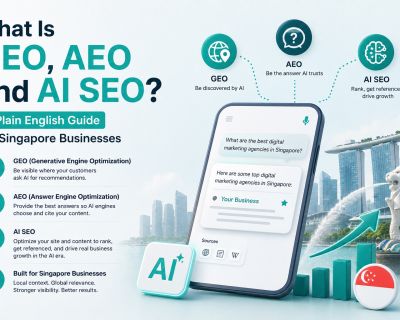
What Is GEO, AEO and AI SEO? A Plain English Guide for Singapore Businesses

Quick Answer
What is the difference between GEO, AEO and AI SEO?

GEO (Generative Engine Optimisation) is the practice of optimising content to be cited by AI search engines like ChatGPT and Perplexity. AEO (Answer Engine Optimisation) focuses specifically on becoming the direct answer to a question in AI-generated responses. AI SEO combines traditional SEO with both GEO and AEO — it is the full strategy for being visible across both Google’s standard results and AI-powered search platforms.

If you have noticed that fewer people are clicking through to your website from Google — even when your rankings have not changed — you are experiencing one of the biggest shifts in digital marketing since the smartphone era. AI search is here. And for Singapore businesses, the window to establish authority before your category locks in is measured in months, not years.
This guide explains three terms you will increasingly hear from marketers: GEO, AEO and AI SEO. We will explain what each one means, how they differ, why they matter for your business in Singapore, and what you can do about it today.
What Is Traditional SEO And Why Is It No Longer Enough?
Traditional Search Engine Optimisation (SEO) is the practice of improving your website’s visibility in Google’s standard search results — the ten blue links that appear when someone searches for something. For the past two decades, ranking on page one of Google was the primary goal of digital marketing.
That model is changing. Google now answers questions directly on the results page through AI Overviews, which appear in more than 25% of all searches. ChatGPT has over 200 million weekly active users globally who ask questions and receive direct answers — without ever visiting a website. Perplexity, Gemini and Microsoft Copilot are all doing the same thing.
The result: a growing share of your potential customers are finding answers — and making decisions — without ever reaching your website. If an AI platform does not know your brand exists, you are invisible to those customers entirely.
What Is GEO Generative Engine Optimisation?
Quick Answer
What is GEO (Generative Engine Optimisation)?
GEO stands for Generative Engine Optimisation. It is the practice of structuring your content, website and online presence so that AI search engines — such as ChatGPT, Perplexity, Google AI Overviews and Gemini — select your brand as a source when generating answers to user queries.
When a user asks ChatGPT a question, the AI does not search Google and show you the results. It synthesises an answer from everything it has learned — and increasingly, from live web searches. The pages and brands it cites as sources are the ones that have been structured and positioned to be machine-readable, authoritative and relevant.
GEO is the discipline of making your content and brand easy for these AI systems to find, understand and cite. It involves:
What Is AEO Answer Engine Optimisation?
Quick Answer
What is AEO (Answer Engine Optimisation)?
AEO stands for Answer Engine Optimisation. It is the practice of optimising your content to become the direct, authoritative answer that AI search engines deliver when a user asks a specific question — making your brand the named source in AI-generated responses.
AEO is closely related to GEO but has a more specific focus. Where GEO is about being visible across AI platforms broadly, AEO is about being the answer — the specific brand or source that an AI cites when someone asks a question directly relevant to your business.
Think of it this way: if a Singapore business owner asks Perplexity ‘What is the best digital marketing agency in Singapore for SEO?’, AEO is the work that puts a specific agency’s name in that answer. The AI has effectively made a recommendation — and AEO is how you engineer your way into those recommendations.
AEO relies heavily on:
What Is AI SEO?
Quick Answer
What is AI SEO?
AI SEO is the integrated approach that combines traditional SEO (ranking on Google’s standard results) with GEO and AEO (being cited in AI-generated responses). It is the full search visibility strategy for 2026 and beyond — ensuring your brand is found whether a user searches the traditional way or asks an AI platform directly.
AI SEO is not a replacement for traditional SEO — it is an evolution of it. The fundamentals still matter: quality content, technical health, backlinks, and E-E-A-T signals (Experience, Expertise, Authoritativeness, Trustworthiness). But those fundamentals now need to be extended with GEO and AEO techniques to ensure visibility across AI platforms as well as Google’s standard results.
An AI SEO strategy covers:
GEO vs AEO vs SEO A Clear Comparison
Traditional SEO
GEO
Goal
Rank on Google’s top 10 results
Be cited in AI-generated answers
Platform
Google (standard results)
ChatGPT, Perplexity, AI Overviews, Gemini
Success metric

Sets basic strategy and executes it

Citation frequency and brand mention share
Content style
Keyword ranking position 1–10
Direct answers, FAQ format, entity-rich
Links
Backlinks to improve domain authority
Third-party mentions, citations, reviews
Schema markup
Article, Product, Local Business schema
FAQPage, HowTo, Speakable schema
Measurement
Google Search Console, rank trackers
AI citation monitoring tools
Timeline

Yes — SEO, SEM, SMM, content as agreed

6–12 weeks for initial citation activity
Why Does This Matter for Singapore Businesses Specifically?
Singapore has one of the highest rates of AI tool adoption in Southeast Asia. A growing share of your potential customers — especially professionals, business owners and consumers under 40 — are already using ChatGPT, Perplexity and Google AI Overviews as their primary research and decision-making tool.
When a Singapore professional asks ChatGPT ‘What digital marketing agency should I hire for SEO in Singapore?’ — the AI gives a direct answer, naming specific agencies. If your brand is not among the sources the AI has learned to associate with that question, you do not exist in that customer’s decision-making process.
25%
of all Google searches now show an AI Overview
57%
of Gen Z use AI for purchase research
14.2%
AI search traffic conversion vs 2.8% from Google
80%
of AI-cited URLs do not rank in Google’s top 100

That last statistic is critical: 80% of pages cited by AI search engines do not rank in Google’s top 100 results for the same query. This means AI citation is a separate game from traditional SEO — and a game that most Singapore businesses have not yet started playing.

How M'ai Digital Approaches GEO, AEO and AI SEO
At M’ai Digital, AI search visibility — what we call AI SEO, combining GEO and AEO — is built into every SEO engagement we take on. We do not treat it as a separate service bolted on top of standard SEO. It is how we do SEO.
Our approach covers three layers:
For one healthcare client in Singapore, this approach resulted in over 539 pages across ChatGPT, Perplexity and Google AI Overviews citing their brand as a source — built over 18 months of consistent AI SEO work.
Frequently Asked Questions GEO, AEO and AI SEO
Is GEO the same as SEO?
No. Traditional SEO focuses on ranking in Google’s standard search results — the ten blue links. GEO (Generative Engine Optimisation) focuses on being cited in AI-generated answers from platforms like ChatGPT, Perplexity and Google AI Overviews. The two disciplines share some foundations — quality content, technical health, authoritative backlinks — but require different content structures, schema strategies and measurement approaches.
Do I need to do GEO if I already rank well on Google?
Yes — and increasingly urgently. AI Overviews now appear in more than 25% of Google searches, and 80% of the pages cited in AI answers do not rank in the top 100 Google results for the same query. A strong Google ranking does not automatically translate to AI visibility. They are separate systems that require separate optimisation strategies.
How long does it take to get cited in ChatGPT or Perplexity?
Initial citation activity typically begins within six to twelve weeks of publishing well-structured, GEO-optimised content. Building consistent citation authority across multiple AI platforms takes three to six months of sustained effort. Unlike traditional SEO rankings, AI citation authority compounds over time — each citation builds on the last.
Can small businesses in Singapore benefit from GEO and AEO?
Yes — and in some ways small businesses have an advantage. Many categories in Singapore are not yet contested at the AI citation level, meaning a well-executed GEO strategy from a smaller brand can establish authority before larger competitors take notice. The window for first-mover advantage is open now but will not remain open indefinitely.
How do I know if my brand is currently being cited in AI search results?
The simplest approach is manual testing: ask ChatGPT, Perplexity and Google AI Overviews questions that your target customers might ask, and see whether your brand appears in the responses. For more systematic tracking, tools such as Otterly.AI monitor citation frequency across multiple AI platforms. M’ai Digital offers a free AI visibility audit for Singapore businesses — email hello@mai-digital.sg to find out where you stand.
Find Out Where Your Brand Stands in AI Search
M'ai Digital offers a free AI visibility audit for Singapore businesses. We test your brand across ChatGPT, Perplexity and Google AI Overviews and tell you honestly what we find.

Add Comment